It's Tuesday. Your client's campaign has been live for a week, and the landing page is converting at 1.2%, well below the 2.5% you projected. You know exactly what's wrong. The headline doesn't match the ad. The CTA is buried below the fold. The hero image is wrong for this audience. You could fix it in 20 minutes if you had access. But you don't. It's on the client's site, and their dev team is backed up with other priorities.
You submit a request. You wait. A week passes. The dev team asks clarifying questions. You answer. Another few days. By the time the change finally ships, the campaign has burned through $15,000 at suboptimal performance. The client wants to know why results were weak. You explain the delay. They hear excuses.
The hidden cost of developer dependencies isn't the delay itself. It's everything you didn't do while waiting. Every day a change sits in a queue, you're running suboptimal campaigns, missing test cycles, and giving clients a reason to wonder if you're the right partner. The cost doesn't show up in your invoices. It shows up in your churn rate. For a detailed breakdown of how these bottlenecks form, see why developer queues slow everything down.
If you want the end-to-end workflow for shipping fixes without waiting on a dev queue, start with our main guide on how to edit client websites without developers.
Why Developer Queues Take So Long

The frustrating thing about developer delays is that no one is being slow. The system just isn't designed for speed. It's designed for stability. Understanding why the queue takes so long helps you decide whether to work within it or around it.
Your request goes into a queue, not a to-do list. Developer teams prioritize by urgency and complexity. A marketing copy change isn't urgent (nothing is broken) and it isn't complex (it's just text). So it goes to the bottom, behind bug fixes, feature launches, security patches, and everything else that keeps the site running. You're not being ignored. You're just not a priority. That's the system working as designed.
The handoff creates information loss. You know exactly what you want. But you have to translate it into a request that makes sense to someone who doesn't see your analytics, doesn't know your campaign strategy, and doesn't understand why the current headline isn't working. They ask clarifying questions. You clarify. They ask more. Each round-trip adds 1-2 days, not because anyone is slow, but because communication across context boundaries takes time.
Testing happens on their timeline, not yours. Even after the change is built, it has to go through QA. For the dev team, that's standard process. They can't ship untested code to production. For you, it's another 2-3 days watching a campaign underperform while someone verifies that your headline change didn't break anything.
The total: 2-4 weeks for a change that takes 20 minutes to make. Not because the dev team is incompetent. Because the system is optimized for stability and predictability, not for marketing speed. Those are different goals, and they create different workflows. The question is whether that workflow serves your needs.
The Math of Waiting

Most agencies know delays are annoying. Few have calculated what they actually cost. Here's how to run the math on your own situation.
Step 1: Identify a recent optimization you wanted to make. What was the change? A headline update, a CTA move, a hero image swap? How much traffic does that page get daily?
Step 2: Estimate the improvement. You don't need precision here. If you thought the change would help, you had a number in mind, even if it was rough. A 1% conversion rate bump? A 0.5% lift? Use your best guess.
Step 3: Calculate the daily opportunity cost. The formula is straightforward:
- Daily traffic × current conversion rate = current daily conversions
- Daily traffic × improved conversion rate = potential daily conversions
- Difference × average order value = daily revenue opportunity
Step 4: Multiply by the delay. If it took 14 days to ship, that's 14 × daily opportunity = total cost.

A concrete example: A campaign landing page gets 500 visits per day. Current conversion rate is 1.5%. You believe the change would lift it to 2.5%. Average order value is $80.
- Current: 500 × 1.5% = 7.5 conversions/day
- After change: 500 × 2.5% = 12.5 conversions/day
- Difference: 5 conversions/day
- Daily cost: 5 × $80 = $400
- 14-day delay: $5,600 in lost revenue
That's one change, one page, one campaign. Now multiply by every optimization you wanted to make but couldn't because the queue was too long. Multiply by every test you didn't run because you knew the implementation would take weeks. The numbers add up faster than you'd expect.
The Costs You Can't Calculate

Some costs don't fit in a spreadsheet. They're real, but they're invisible until they become a crisis.
Tests you didn't run. Every test has a cost: time to set up, time to run, time to analyze. But the bigger cost is the tests you never started because you knew the change would take too long to implement. You self-censored your optimization ideas based on what was feasible, not what was valuable. How many test ideas have you deprioritized because "the dev team will never get to that"? Those ideas weren't bad. They just weren't worth the wait. That's a different kind of loss.
Clients who wondered if you were the right fit. Clients don't see your Jira board. They don't know you submitted a request three weeks ago that's still sitting in queue. They just see results, and when results are slow, they assume you're slow. Churn rarely happens because of one delay. It happens because delays accumulate into a sense that things aren't moving. By the time the client says something, they've already been talking to other agencies. The conversation you're having is the exit interview, not the warning.
Opportunities with expiration dates. Some optimization windows close. A seasonal campaign. A product launch. A trend that's hot this week and forgotten next month. If your change ships after the window closes, the change was worthless, regardless of how good it was. You can't calculate the revenue from a Black Friday optimization that shipped on December 1st. But you know it wasn't zero.
When Developer Dependencies Make Sense

Not every change should bypass developers. Some changes genuinely require their expertise, and pretending otherwise would be reckless. The goal isn't to eliminate developer involvement. It's to reserve it for work that actually needs it.
You need developers when:
- The change involves custom functionality: forms, integrations, dynamic content that pulls from databases
- The change touches site infrastructure: hosting configuration, security settings, authentication flows
- The change requires access to the codebase: backend logic, database schema changes, API integrations
- The risk of breaking something is high and hard to reverse: structural changes that could cascade
You don't need developers when:
- You're changing text, images, or layout on an existing page
- You're creating variations for different campaigns or audiences
- You're testing different messaging to see what converts
- You can roll back in seconds if something goes wrong
Most marketing optimizations fall into the second category. The problem is that agencies treat all website changes as developer work because they don't have another option. When the only tool you have is a dev request, every change looks like a dev ticket. For a clearer framework on when to involve developers and when to work independently, see when agencies need developers.
What Eliminating This Bottleneck Looks Like

The difference between a developer-dependent workflow and an independent one isn't just speed. It's the entire rhythm of how you optimize.
The old workflow:
The new workflow:
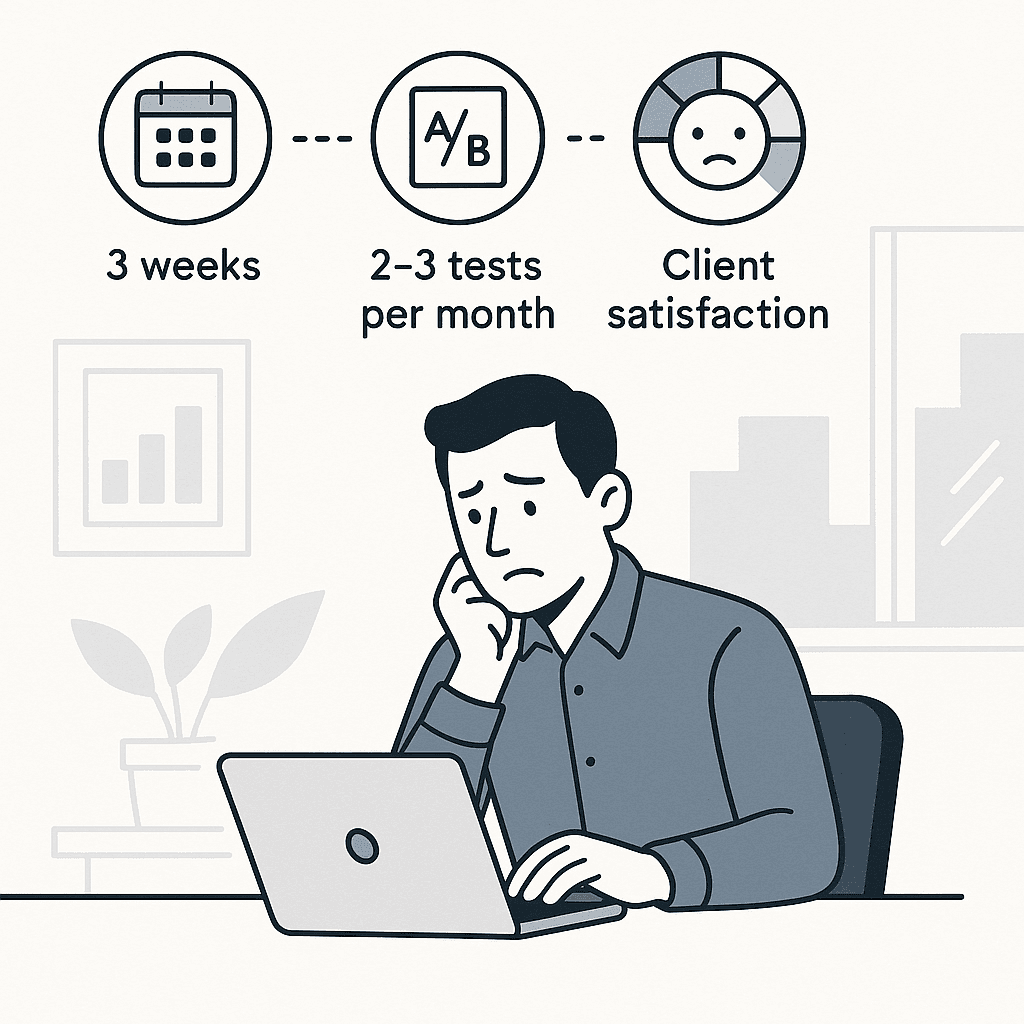
The difference isn't just that you save 3 weeks. It's that you can test three ideas this week instead of one idea this month. You learn faster because you're not waiting to learn. You optimize faster because iteration cycles are hours, not weeks. You deliver results faster because you're not dependent on someone else's queue.
How to Make the Business Case

If you're convinced the bottleneck is costing you, here's how to build the case for changing it.
Track your current delays. For the next 30 days, log every marketing change you request. Note when you submitted it and when it went live. Calculate the average delay. If you don't have data, you don't have a case, so start collecting it.
Estimate the monthly cost. Pick 3-5 changes from your log and run the math from earlier. Be conservative: use lower-bound estimates for improvement and higher-bound estimates for delay. If the total is still significant, you have a case. If it's marginal, maybe the current workflow is fine.
Compare to the alternative. No-code editing tools cost money. Calculate the break-even point. If you're losing $5,000/month to delays and the tool costs $500/month, the ROI is obvious. If the numbers are closer, factor in the intangibles: client satisfaction, team morale, competitive positioning.
Start with one client. Don't overhaul everything at once. Pick one client with active optimization needs and a willingness to try something new. Run the independent workflow for 60 days. Measure test velocity, time-to-implementation, and results. Use that data to decide whether to expand.
The Real Bottom Line

Developer dependencies feel normal because everyone has them. Waiting feels like part of the job, just another friction you work around. But friction has a cost, even when you stop noticing it. Every day you wait is a day of suboptimal performance, a day closer to a client wondering why things move so slowly, a day your competitors might be using to pull ahead.
The question isn't whether you can afford to change the workflow. It's whether you can afford to keep waiting.
Calculate Your Hidden Cost
- Log your next 5 change requests: Note submission date, go-live date, and the page involved.
- Calculate delay cost for each: Use the formula: daily traffic × conversion lift × AOV × days delayed.
- Sum the monthly impact: Multiply by the number of changes you typically request per month.
- Compare to alternatives: Research no-code editing tools and calculate break-even.
- Pilot with one client: Run an independent workflow for 60 days and measure the difference.

Stop Waiting for Developers
Every day a change sits in a queue, you're running suboptimal campaigns and giving clients a reason to look elsewhere. The hidden cost of developer dependencies isn't the delay. It's everything you didn't do while waiting. Calculate your cost, make the case, and start moving at the speed of marketing.