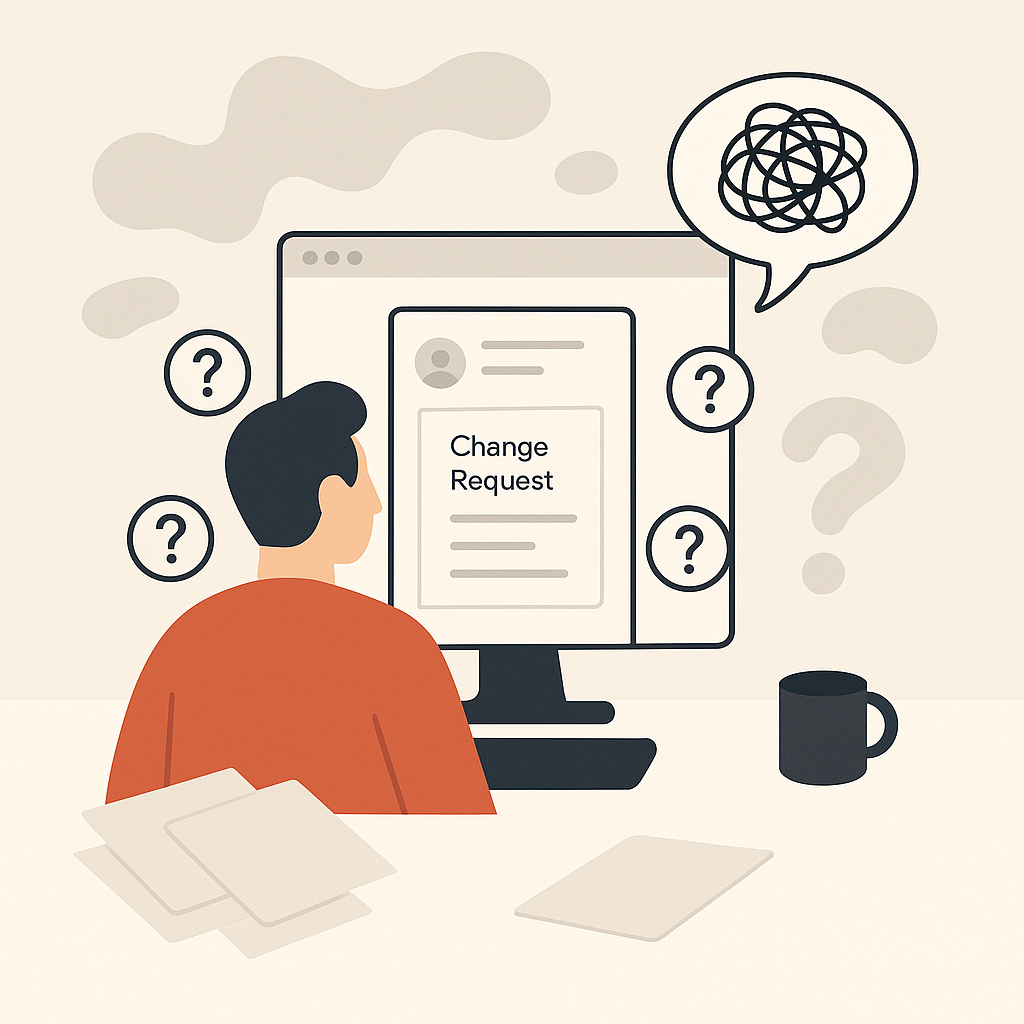
At first, no governance can feel fine.
A few requests a month.
One stakeholder.
One person “just knows” what to do.
Then volume increases.
Or the team changes.
Or results dip.
And suddenly you’re asking:
“Why is every small change a fight?”
If you want the full governance model and the week-one setup, start here:
client website governance for agencies
Why It Feels Fine… Until It Doesn’t

Early-stage chaos is hidden.
Because it’s carried by a person.
Someone remembers what the client hates.
Someone knows who to ask.
Someone keeps the inbox stitched together.
Then that person gets busy.
Or leaves.
Or you add clients.
And the “system” collapses.
Not because people got worse.
Because the decisions were never written down.
9 Signs Your Client Website Has No Governance

If you want the quick scan, use this table first.
| Sign | What it looks like in real life |
|---|---|
| Nobody owns the decision | You can’t name who has final say on a change |
| Requests are scattered | Work arrives via messages, calls, emails, and “quick asks” |
| Approval fights and reversals | Changes get approved, then unapproved later |
| Drive-by edits | Stakeholders change pages without review |
| Rewriting the same pages | The same section gets rewritten every month |
| “Not in scope” is constant conflict | Boundaries aren’t clear, so everything feels negotiable |
| Blame when results change | “What changed?” becomes a recurring crisis |
| Everything is treated as high risk | Teams slow down because there’s no fast path |
| Onboarding is reinvented every time | Every client has a different unwritten rule set |
Sign 1: Nobody owns the decision
Decision rights are unclear.
So debates don’t end.
Sign 2: Requests are scattered
There’s no intake path.
So context is always missing.
Sign 3: Approval fights and reversals
There are no risk tiers.
And no definition of what counts as approval.
Sign 4: Drive-by edits
People can edit without review.
And the system has no way to route changes.
Sign 5: Rewriting the same pages
There are no standards.
So “good” is subjective.
Sign 6: ‘Not in scope’ is constant conflict
Boundaries aren’t agreed.
So every request becomes negotiation.
Sign 7: Blame when results change
There’s no shared visibility into what shipped and why.
So the last visible change becomes the suspect.
Sign 8: Everything is treated as high risk
No tiers means no fast path.
So velocity collapses.
Sign 9: Onboarding is reinvented every time
You don’t have a baseline governance model.
So every client becomes a custom ruleset.
What to Fix First (The Order Matters)

If you fix these out of order, you’ll feel like governance “doesn’t work.”
Because the inputs are still chaos.
Here’s a simple order that restores momentum fast.
These posts map to that order:
- Intake Website Change Requests Without Chaos
- Who Decides What on a Client Website? For Agencies
- Lightweight Approval Workflows for Website Changes
- Website Standards for Agencies: Stop Rewriting Pages
For an external baseline on change control:
U.S. government guide on configuration and change control
And for reducing user-facing errors that turn into rework:
NIST guidance on secure design and reducing errors
Getting Started: Fix Governance in One Client This Week

Pick one client where chaos shows up weekly.
Then fix the inputs.
Not the symptoms.
Fix governance in one client this week
- Set one intake path: One place requests go, with required context.
- Define decision rights: Name who decides for common change types.
- Add approval tiers: Low/medium/high risk with explicit sign-off rules.
- Write a one-page standards sheet: Define the quality floor so reviews stop being subjective.
- Clarify boundaries: Separate ownership vs access so accountability is clear.
- Run one real request through the system: Practice end-to-end, then adjust.