Your offer is solid. The traffic is qualified. People are interested. You can see it in the scroll depth, the time on page, the repeat visits. But they don't convert. They hesitate at the moment of action and leave without doing anything.
The common interpretation is "they don't trust us." But that's not quite right. Most visitors aren't thinking "this looks like a scam." They're thinking "I'm not sure yet." That hesitation isn't rejection. It's a decision in progress. And the page isn't giving them what they need to finish it.
Trust is gradual, not binary. It builds in steps, and each step requires different proof. When visitors stall, it's usually because one of those steps is missing, not because they've decided against you. This is one of the core reasons websites get traffic but no leads, and it's fixable once you understand which step is broken.
The Misread: "They Don't Trust Us"

When conversions stall, teams often blame trust in general terms. "We need more testimonials." "We need more logos." "We need to look more credible." These are vague responses to a specific problem.
The real question isn't whether visitors trust you. It's which trust step they're stuck on. A visitor who doesn't understand what you do needs different proof than one who understands but isn't sure it fits their situation. A visitor who believes it works needs different proof than one who isn't sure the next step is safe.
Treating trust as a single thing leads to scattered fixes, testimonials here, badges there, a guarantee somewhere else. But if you haven't identified the specific hesitation, you're adding noise instead of signal.
Trust Builds in Steps (And Each Step Has a Different Proof Need)
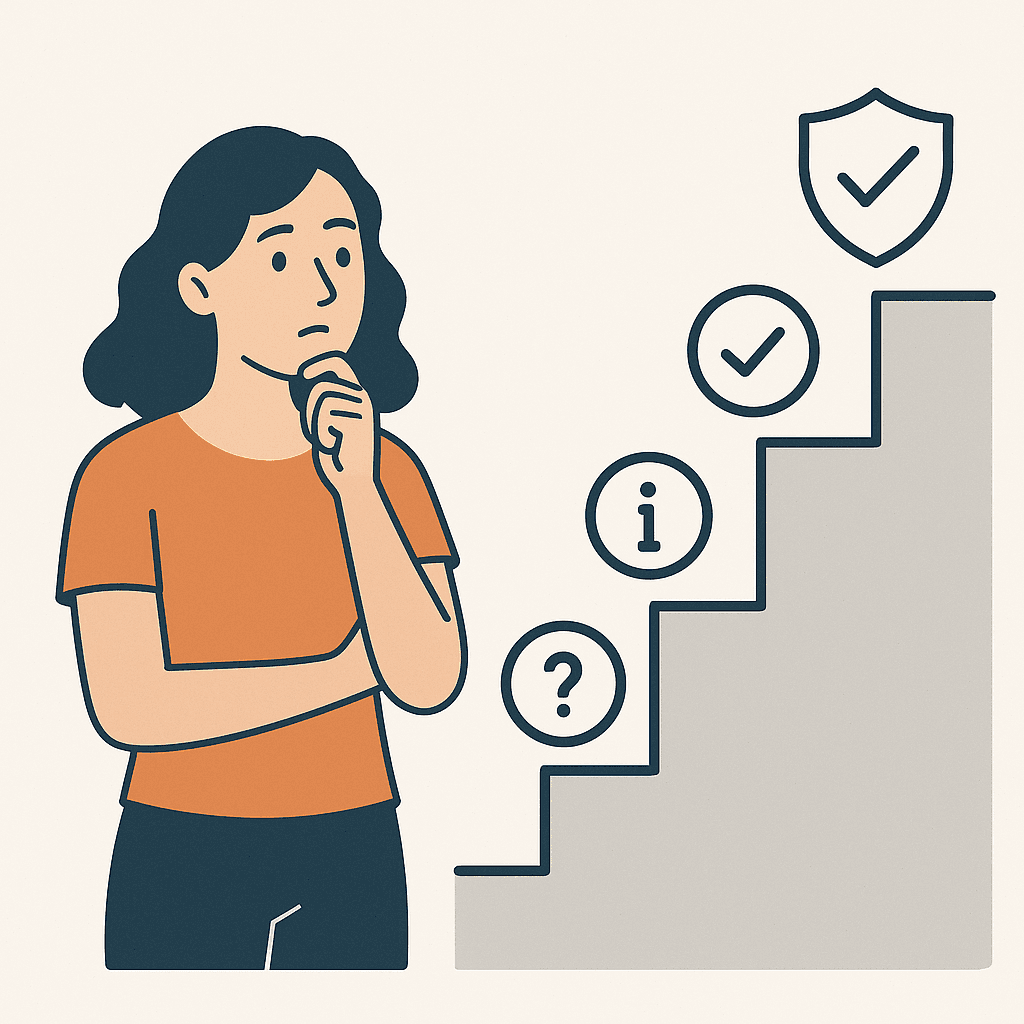
Every visitor moves through a sequence of decisions before they act. At each step, they're trying to rule something out. If they can't, they stall.
Step 1: "Is This For Me?"
Before anything else, visitors need to know whether this is relevant. They're not evaluating quality yet. They're evaluating fit. If they can't tell quickly whether this solves their problem for their situation, they leave.
The proof for this step is clarity: who it's for, what problem it solves, and what it doesn't do. Vague positioning creates hesitation because visitors can't rule themselves in or out.
Step 2: "Is It Real?"
Once relevance is established, visitors need to believe the thing works. Not for them specifically, just in general. They're looking for signs of competence: specificity, examples, visible expertise, constraints that suggest you understand the problem.
Abstract claims create hesitation at this step. "We help businesses grow" doesn't prove anything. "We've helped 200 agencies reduce developer wait times by 70%" does. The proof is credibility through specificity.
Step 3: "Will It Work for My Situation?"
This is where most hesitation happens. The visitor believes it works. They're just not sure it will work for them. Their situation feels different. They have constraints, edge cases, or past failures that make them cautious.
The proof for this step is fit: scenarios that mirror their reality, case studies from similar contexts, common objections addressed, constraints acknowledged. When visitors see their situation reflected, they can imagine success. When they don't, they hesitate.
Step 4: "Is the Next Step Safe?"
Even when visitors believe it works and believe it will work for them, they can still stall at the ask. If the next step feels too big, too much commitment, too much risk, too irreversible, they delay.
The proof for this step is risk reduction: clear expectations, low-commitment options, reversibility, or a visible path to change their mind. When the next step feels safe, action becomes easier.
Common Trust Failures That Look Like "Bad Copy"

When conversions are low, the instinct is to rewrite. But often the problem isn't the words. It's the missing proof.
Vague claims fail at Step 2. "We're the best" doesn't prove competence. Specific results do. Abstract language fails at Step 3. "We help businesses like yours" doesn't prove fit. Showing their scenario does. Big asks fail at Step 4. "Book a demo" might be too much if they're still deciding whether to explore. A smaller step might convert where the bigger one stalls.
Proof in the wrong place fails because sequencing matters. A wall of testimonials doesn't help if the visitor isn't sure yet whether this is for them. They need Step 1 proof first.
How to Decide What Proof to Add (Without Turning the Page Into a Wall)

The fix isn't to add more proof everywhere. It's to add the right proof for the step where visitors are stalling.
Start by identifying where hesitation happens. If visitors bounce quickly, they're probably stuck at Step 1. They can't tell if it's for them. If they read deeply but don't engage, they might be stuck at Step 2 or 3. If they start forms but don't submit, they're likely stuck at Step 4.
Then add proof that addresses that specific hesitation. One targeted proof element is more effective than five scattered ones. The goal is to answer the visitor's actual doubt, not to overwhelm them with everything you've got.
Keep the page calm. Trust isn't built through volume. It's built through relevance. A few well-placed proof points that match the visitor's stage will outperform a crowded page every time.
Getting Started: Identify the One Doubt Blocking the Next Step
Add the right proof to one stall point
- Pick one page with conversion hesitation. Look for pages with high engagement but low action.
- Identify where visitors stall. Quick exits = Step 1. Deep reading without action = Step 2 or 3. Form abandonment = Step 4.
- Name the doubt. What question is the visitor stuck on at that step?
- Add one targeted proof element. A specific example, a relevant constraint, or a risk-reducing next step.
- Remove competing noise. If you have scattered proof that doesn't address the stall, simplify.