Your website gets traffic but no leads. People are clicking. They're arriving. And then nothing happens.
This is one of the most frustrating patterns in marketing because everything looks like it should work. The ads are running. The numbers say people are showing up. But somewhere between the click and the conversion, you're losing them.
Most teams treat this like a guessing game. Maybe it's the headline. Maybe the offer isn't strong enough. Maybe the page is ugly. So they start tweaking button colors, copy, and layout, hoping something sticks.
If you're running paid campaigns, that guessing game gets expensive fast. You don't get six months to figure it out. You get a few weeks. Sometimes one billing cycle.
So let's stop guessing.
The Real Problem: They Clicked, but They Didn't Decide
If your site is getting traffic, you already did the hard part. You got their attention. The ad worked. The email got opened. The search result earned the click.
Now you're losing them at the moment they're trying to answer three questions:
- Is this actually for me? Does this page understand what I'm trying to do?
- Can I trust this? Not "is this a scam," but "am I sure enough to act?"
- What happens next? Is the next step clear, safe, and worth it?
When those questions stay unanswered, or when the answers feel wrong, people don't say "no." They just leave. They tab away. They tell themselves they'll come back later. And then you pay to retarget them, and the cycle repeats.
More traffic won't fix this. It just sends more people into the same stall.
Traffic and Conversion Are Two Different Jobs

Here's where the confusion starts.
Traffic has one job: get the right person to show up for the right reason. Conversion has a different job: help that person decide, then help them act.
These are separate problems with separate fixes. But most teams blur them together. When leads are down, they buy more clicks. Or they rewrite headlines. Or they redesign the whole page. None of those are the fix until you know why people stalled. If you're not sure which one you're dealing with, the distinction between a traffic problem and a conversion problem is the first thing to sort out.
The 4 Reasons People Leave Without Converting
Most "traffic but no leads" situations come down to four issues. You can argue about which one you have. But you can't fix anything until you pick one and test it.
1. Intent Mismatch
The visitor came to answer one question. Your page is answering a different one.
Maybe your ad promised a comparison, but your landing page is a product pitch. Maybe someone searched "how to fix X" and landed on a page selling a tool for Y. The traffic is "good" by every metric, but the page isn't serving the intent that arrived.
This is the most common failure, and it's invisible in most dashboards. You'll see bounce rates, but you won't see why they bounced. When intent mismatch is the problem, even the right people do nothing, because the page is solving a decision they didn't come to make.
2. Trust Isn't There Yet
Most visitors aren't thinking "this looks like a scam." They're thinking "I'm not sure yet." They want to believe you. They're just not ready to act.
This isn't a copy problem. It's a proof problem, and specifically, a sequencing problem. The right proof at the wrong time doesn't land. You need to build confidence in the order the visitor needs it, not the order that fits your page layout. The key insight is that trust is gradual, not binary. People don't flip from skeptical to sold in one moment.
3. The Ask Came Too Early
Your CTA is visible. Your form is above the fold. Everything looks optimized.
But the ask is too big for this moment. The visitor hasn't decided yet, and you're already asking for the commitment. When that happens, making the CTA louder usually makes things worse. These commitment timing errors are tricky because the page looks fine. The problem is invisible until you think about where the visitor actually is in their decision.
4. The Page Is Trying to Do Too Many Jobs
Some pages are built to route people. Some are built to educate. Some help people compare options. Some are built to close a decision.
When a single page tries to do all of these at once, it usually does none of them well. This is especially common on homepages and blogs. Homepages fail to convert when they try to serve everyone at once instead of routing visitors to the right next step. Blogs get traffic but no leads when they attract attention but don't move it anywhere useful.
How to Sort the Problem (Before You Touch Anything)

You don't need a dozen dashboards to figure out what's broken. You need one honest pass through the page like a visitor, and then one pass through your traffic sources like a marketer.
Here's the quick version:
- What did this visitor come here to do? From the ad, email, or search query, write the visitor's goal in one sentence.
- What job is this page doing? Is it educating, comparing, proving, or capturing? Pick one. If you can't pick one, that's a clue.
- What's the missing proof? What would a cautious but interested visitor need to see before they'd act?
- Is the ask too big? Are you asking for a commitment before the visitor has made a decision?
If you want a faster shortcut, use this:
| What you see | What it usually means |
|---|---|
| People bounce fast and don't scroll | Traffic or page-promise mismatch |
| People scroll and read, then leave | Intent mismatch or missing proof |
| People start a form but don't finish | Trust gap or ask is too early |
| People click around but never take the big step | Commitment timing |
What "Better" Looks Like
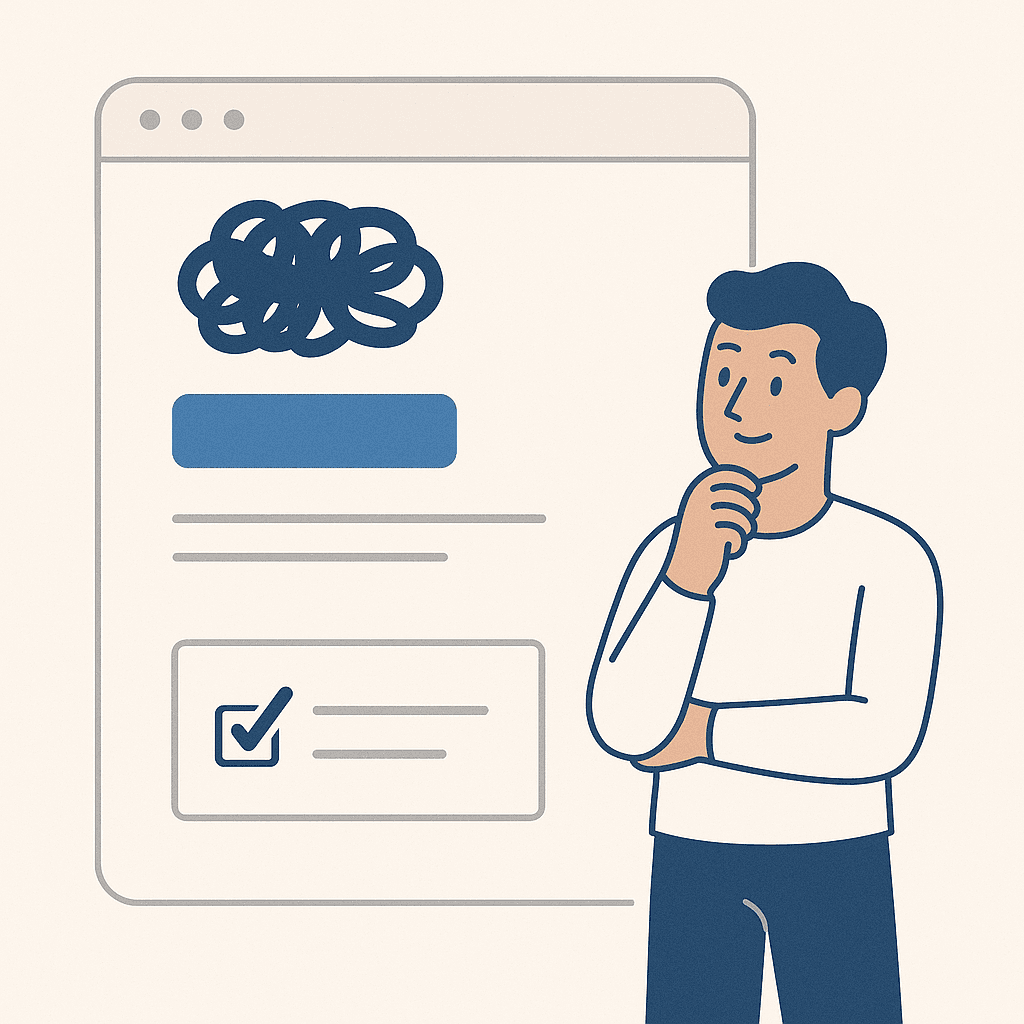
Better doesn't mean more aggressive. It means clearer and calmer. The visitor can answer their own questions without doing detective work.
A page that works usually has
If you're already thinking "maybe we should just redesign the whole thing," pause. That instinct usually means the decision structure is broken, but a redesign won't fix it. The question of redesign vs optimization is worth settling before you commit to either path.
Getting Started: Fix One Page This Week

You don't need to overhaul the whole site. You need one page to stop bleeding. Then another.
Fix the decision path on one page
- Pick one page with real traffic. The one getting attention now, not the one you wish people visited.
- Pick one traffic source. One campaign, one email, or one search query. Write the visitor's goal in one sentence.
- Name the page's job. Educate, compare, prove, or capture. One job only.
- Find the stall. Where does a cautious visitor get stuck? Missing proof? Wrong next step? Premature ask?
- Make one change. Add one proof beat. Swap one big ask for a smaller step. Remove one distraction.
- Then optimize. Once the page has a working decision path, you can refine layout, copy, and friction.