If you're asking "traffic vs conversion problem," you're already ahead of most teams. They don't diagnose. They react. Clicks go up, leads stay flat, and someone says "we need more traffic" while someone else says "the page needs a rewrite." A week later, nothing has changed except the budget.
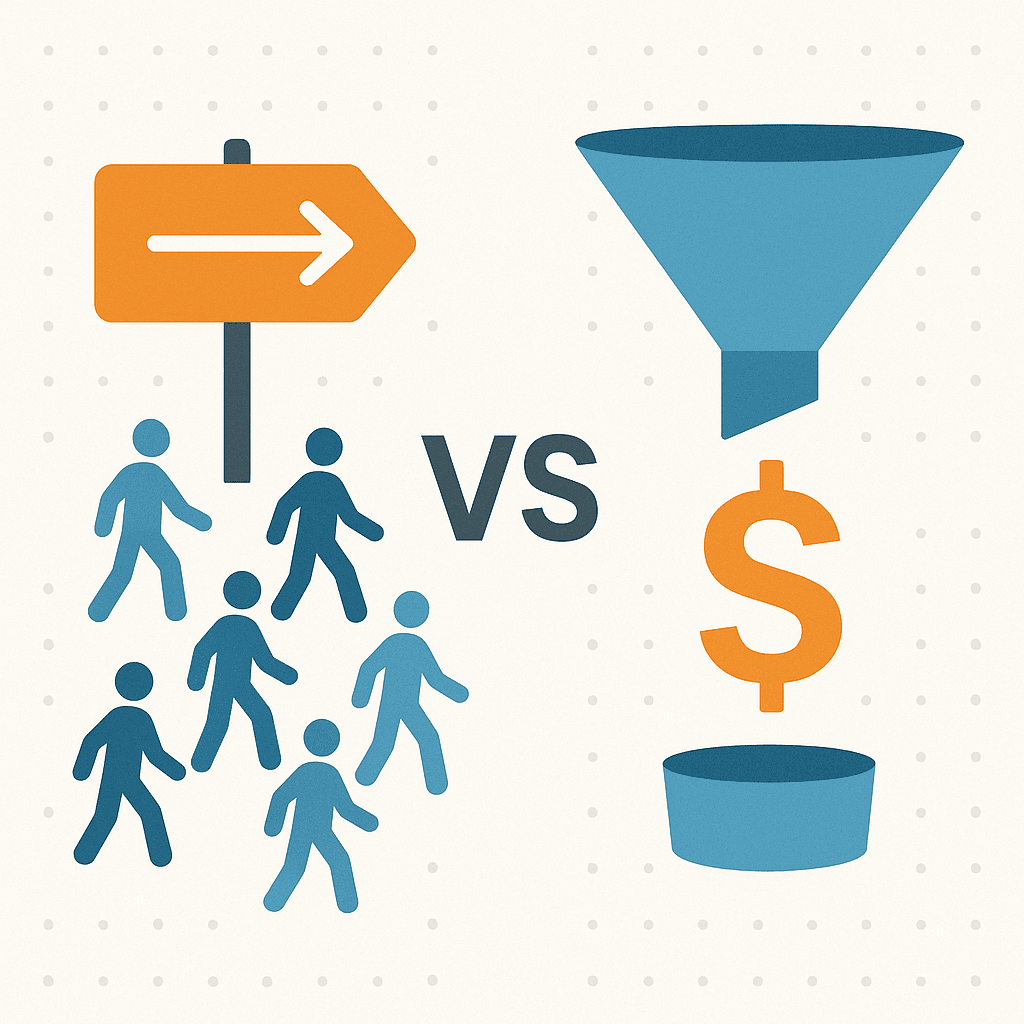
This article is about the fast diagnosis that stops that loop. It fits into the broader framework for understanding why websites get traffic but no leads or sales, but it focuses on one specific question: is the problem upstream (traffic) or downstream (conversion)?
Getting this wrong is expensive. If you treat a conversion problem like a traffic problem, you buy more clicks and learn the same lesson twice. If you treat a traffic problem like a conversion problem, you spend weeks polishing a page that's receiving the wrong audience. Either way, you lose time and money diagnosing the wrong thing.
The Mistake: Treating Every Failure Like a Traffic Problem

When conversions drop, the default instinct is to buy more traffic. The logic feels sound: if 1,000 visitors gave us 10 leads, maybe 2,000 visitors will give us 20. But that only works if the traffic is right and the page is converting. If the page is broken, doubling traffic just doubles the waste.
The harder truth is that "no leads" can mean two completely different things. Either the wrong people are showing up, or the right people are showing up and can't make a decision. Those are not solved the same way, and treating them interchangeably is how teams burn through budgets without learning anything.
What a Traffic Problem Looks Like (In Practice)

A traffic problem is a mismatch problem. The person who arrived isn't the person the page was built for, or they arrived expecting something the page doesn't deliver. Here's how to spot it:
| Signal | What it usually means |
|---|---|
| Fast exits across most sources | The promise and destination don't match |
| People don't scroll | They didn't find what they expected |
| High clicks from one campaign, no engagement | That campaign is sending wrong intent |
The "Wrong Promise" Pattern
Your ad promises something specific. The visitor clicks expecting that thing. But the landing page is vague, or it's pitching something adjacent, or it's trying to serve too many audiences at once. The visitor feels misled, not because you lied, but because the experience didn't match the expectation. They leave within seconds.
This is why "better copy" on the page often fails to move the needle. The problem isn't the page. It's the gap between what the ad promised and what the page delivers. Fix the match before you fix the page.
The "Right Click, Wrong Destination" Pattern
Sometimes the click is correct. The visitor is genuinely interested and genuinely qualified. But they land on the wrong kind of page for their intent. Maybe they wanted to compare options and you sent them to a product pitch. Maybe they wanted to understand the problem and you sent them straight to a demo request.
This looks like a conversion problem in the data. People arrive and don't convert. But it's actually a routing problem. The traffic is fine; the destination is wrong.
What a Conversion Problem Looks Like (In Practice)

A conversion problem is a decision problem. People arrive with real intent, but something stops them from moving forward. The signs are different:
- People scroll deep, read carefully, then leave
- People return multiple times but never act
- People start forms and abandon halfway through
- People click around but never take the final step
These patterns tell you the traffic is probably right. The visitor is interested. They're just stuck on a decision the page isn't helping them make.
Trust Readiness vs Pressure
Most visitors aren't thinking "this is a scam." They're thinking "I'm not sure yet." They want to believe you. They just don't have enough evidence. If your page jumps to pressure before building confidence, they do the safest thing: nothing.
This isn't a copy problem. It's a proof sequencing problem. The page is asking for commitment before the visitor has enough reason to give it. The deeper model is that trust is gradual, not binary, and the page needs to build it step by step.
Timing Errors That Stall Action
A visible CTA can still be wrong if the visitor isn't ready for that step. If your only next step feels like a leap (book a call, start a trial, talk to sales), visitors who aren't ready have no path forward. They delay, intending to come back. Most don't.
For the full breakdown of how this happens, read about commitment timing errors.
The 10-Minute Diagnosis: Four Questions That Sort the Problem

You don't need a dashboard to run this. You need four honest questions:
The most common trap: you see "no leads" and buy more traffic. Result? You spend more money to learn the same lesson. Diagnosis before action.
What to Fix First Once You Know the Category

If it's a traffic problem, fix the match first. Is the ad setting an expectation the page fulfills? Is the traffic being routed to a page with the right role for that intent? Don't polish the page until the traffic is correct.
If it's a conversion problem, fix the decision path. What proof is missing? What's stalling the visitor? Is the ask coming before readiness? The page might not need more content. It might need better sequencing.
Only after those structural issues are addressed should you optimize tactics. Headlines, button colors, and layout tweaks are useful, but only when the foundation is sound.
Getting Started: Diagnose One Page, One Source, One Next Step
Run the 10-minute diagnosis
- Pick one page. The page getting the most paid clicks right now.
- Pick one source. One campaign or one query group.
- Write the visitor's intent. One sentence describing what they're trying to decide next.
- Name the page role. Educate, compare, prove, or capture.
- Find the stall. Mismatch, missing proof, or premature ask.
- Route to the right fix. Traffic issue → routing/promise match. Conversion issue → decision path.