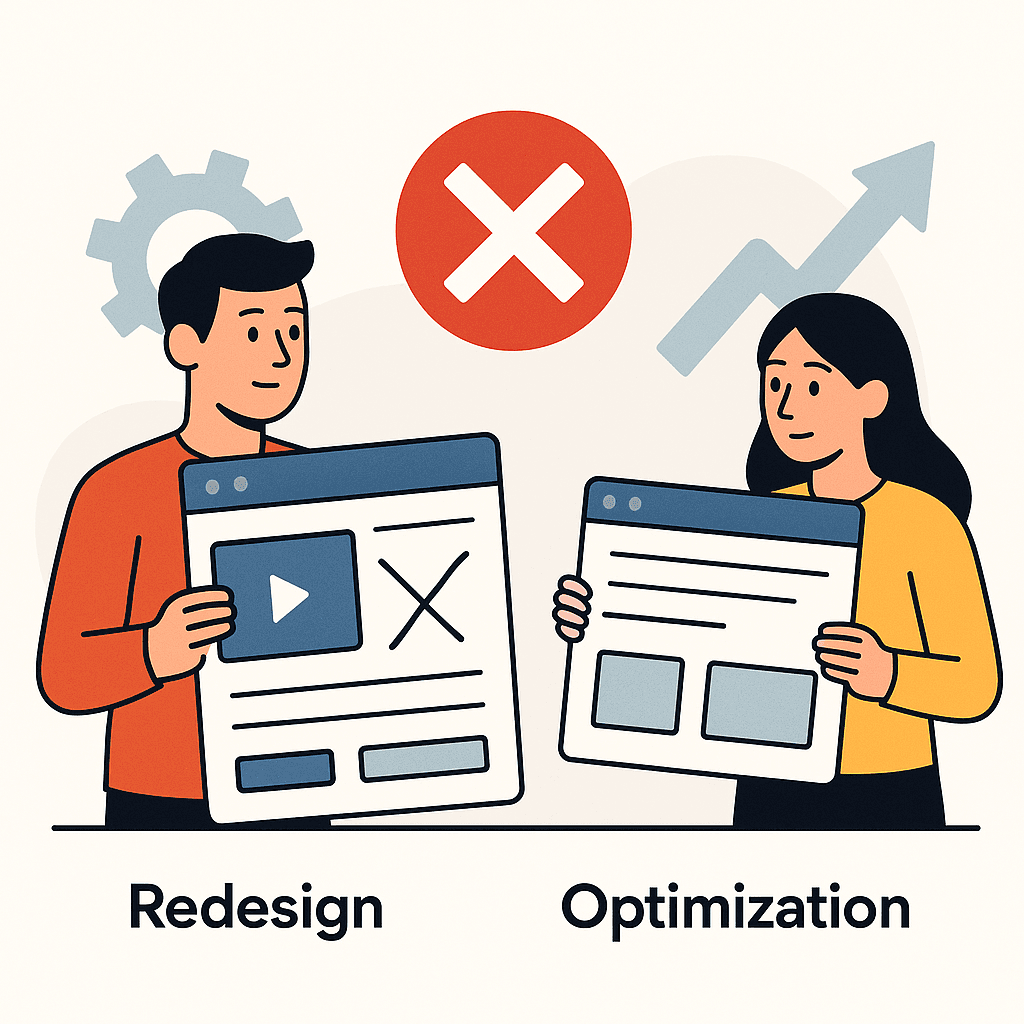
Nothing converts. Patience is running out. Stakeholders are asking why the site looks the way it does, and someone suggests: "Maybe we just need to redesign."
It sounds decisive. A fresh start. A new page that doesn't carry the baggage of previous attempts. But redesign vs optimization isn't a creative decision. It's a diagnostic one. Getting it wrong costs months of effort on something that won't fix the real problem.
A redesign can reset clarity and trust. Or it can waste a quarter on the wrong lever. The difference is knowing whether the issue is structural or tactical. This connects directly to understanding why websites get traffic but no leads, and which category of fix you actually need.
Why This Decision Feels So Hard
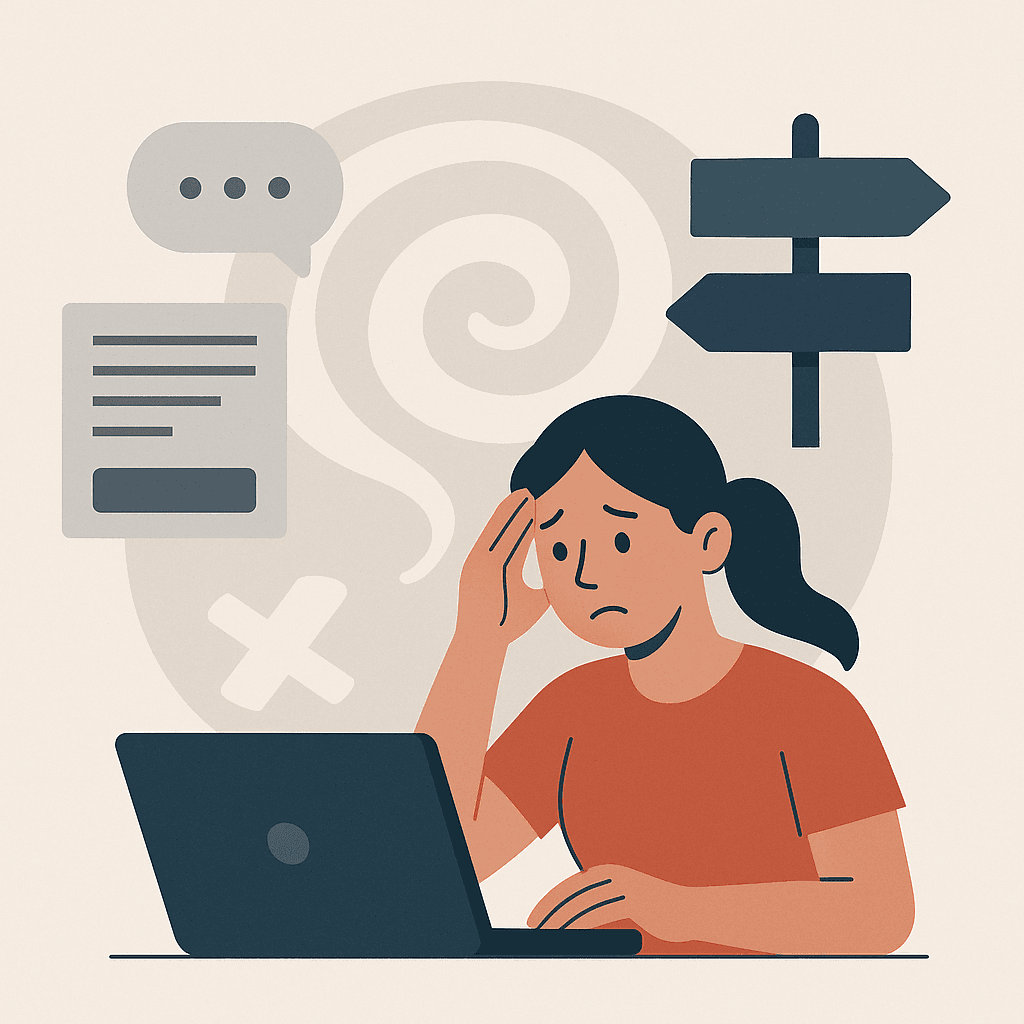
When conversions are weak, everything feels broken at once. The copy seems flat. The design seems dated. The CTA seems ignored. It's tempting to declare it all bad and start over.
But that instinct often leads to expensive mistakes. A redesign takes time, months, usually. And if the fundamental issue is intent mismatch or commitment timing, the new design will fail for the same reasons the old one did. The problem wasn't the page's appearance. It was the page's structure.
The real question isn't "should we redesign?" It's "what exactly is broken, and would a redesign fix it?"
What Optimization Can Fix (And What It Can't)

Optimization improves a working decision path. It sharpens clarity. It refines proof. It reduces friction. These are adjustments to a page that's fundamentally sound but underperforming on execution.
Optimization can fix unclear headlines, weak proof points, friction in forms, poor visual hierarchy, and messaging that doesn't resonate. These are execution problems. The structure is right, but the details need work.
Optimization cannot fix a page trying to serve multiple intents at once, traffic routed to the wrong page role, proof that can't be sequenced coherently, or a next step that's inherently too big for the visitor's stage.
If the page's structure is wrong, if it's trying to do a job it can't do, optimization won't save it. You can polish forever, but if the foundation is off, the polish doesn't matter.
The One Test: Is Page Intent Broken?

Here's a simple test. Can a qualified visitor tell, within the first screen:
- What this is? (What you're offering)
- Who it's for? (Whether it fits them)
- What happens next? (What they're being asked to do)
If the answer is unclear, or if the page tries to answer all three for multiple audiences at once, the problem is structural. That's a redesign signal, not an optimization opportunity.
This test isn't about aesthetics. It's about intent. A page can look beautiful and still fail because it's answering the wrong question for the visitor who arrived.
4 Redesign Signals (Structural, Not Aesthetic)

If you're seeing these patterns, optimization probably isn't enough.
Signal 1: The Page Is Trying to Serve Multiple Decisions
Some pages try to educate, compare, prove, and capture, all at once. The result is a page that can't go deep on any single path. Visitors get a little of everything but not enough of anything.
This usually happens on homepages or core landing pages that have grown over time. Everyone added their priority. Now the page is a patchwork of competing messages.
Why redesign: You can't optimize a page with no focus. You have to pick a primary role and rebuild around it.
Signal 2: Traffic Intent Doesn't Match the Destination
The traffic source has a clear intent, but the page doesn't match. Education traffic arrives at a sales page. Comparison traffic arrives at a product pitch. Branded traffic arrives at a generic landing page.
This is a routing and role problem. The page isn't wrong in isolation. It's wrong for the traffic it's receiving.
Why redesign: Optimization can't fix a mismatch. You either need to reroute the traffic or redesign the page to match the intent.
Signal 3: Proof Can't Be Sequenced
Even good proof can feel random when the structure doesn't support it. Testimonials appear before the visitor understands what you do. Case studies show up before relevance is established. The proof is there, but it's in the wrong order, because the underlying structure doesn't allow proper sequencing.
Why redesign: Proof sequencing requires structural changes. You can't just move sections around. You need to rethink the flow.
Signal 4: The Next Step Is Inherently Risky
Some pages have CTAs that are too big for the visitor's stage, and there's no room for a smaller step. "Book a demo" is the only option. "Talk to sales" is the only path forward.
Why redesign: Adding a smaller step often requires structural changes. You need to create a new path, not just tweak the existing one.
If You Don't Redesign: What to Optimize First

If the page passes the intent test, if it has a clear role, matches its traffic, and has a coherent flow, then optimization can work. Here's the priority order:
- Intent alignment and page role. Make sure the page is doing one job clearly.
- Trust progression. Sequence proof so it matches the visitor's stage.
- Commitment timing. Adjust the ask so it matches readiness.
- Micro-optimizations. Tweak headlines, buttons, layout, and friction.
Most teams start at step 4. They change buttons and headlines without fixing the structure above. That's why their optimizations don't compound. They're polishing a page that's fundamentally misaligned.
Getting Started: Decide in One Hour, Not One Month

Diagnose redesign vs optimization
- Pick one underperforming page. The page with the most traffic and worst conversion rate.
- Run the intent test. Can a visitor tell what this is, who it's for, and what to do next, within the first screen?
- Identify the primary traffic source. What intent is arriving on this page?
- Check for intent match. Does the page's role match the traffic's intent?
- Check for structural signals. Is it trying to do too much? Is proof unsequenced? Is the next step inherently risky?
- Decide. If structural signals are present, redesign. If not, optimize.