You ran the test. Variation B beat the control by 12%. You rolled it out site-wide, expecting revenue to climb. Three weeks later, you're sitting in a meeting trying to explain why the winning test didn't translate to winning results. Revenue is flat, maybe even down. Leadership wants answers, and you're not sure what went wrong.
Here's what went wrong: your A/B test measured traffic composition, not copy quality. The "winner" won because it was acceptable to the mix of people who happened to visit during the test window. It didn't win because it was actually better. It won because it offended fewer people. That's not conversion rate optimization for ecommerce. That's finding the least bad option.
Real optimization means matching the message to the visitor. Unsegmented A/B testing can't do that. It finds compromise copy that works okay for everyone and great for no one. If you want results that actually move revenue, you need to stop testing across all traffic and start testing within segments. For a broader look at why conversion problems happen in the first place, see why websites get traffic but no leads.
What A/B Testing Actually Measures

When you run an unsegmented A/B test, you're asking a simple question: "Which of these two options does my traffic prefer?" The problem is that your traffic isn't one thing. It's made up of different people with different intents, arriving from different campaigns, at different stages of the buying process. The "winner" you crown is really just the option that performed slightly better across that messy mix.
Consider a bed and bath retailer running two hero section variations. Hero A features luxury robes with spa imagery and "treat yourself" messaging. Hero B shows baby essentials with family imagery and "new parent must-haves" copy. Both are good for their respective audiences. But when you test them against each other without segmentation, the result tells you almost nothing useful.
If 60% of your traffic comes from a robes campaign and 40% comes from a baby essentials campaign, Hero A will probably win. It's speaking directly to the majority. But that win comes at a cost: Hero A actively repels the baby shoppers. They land, see robes everywhere, and assume they're in the wrong place. You're not optimizing. You're narrowing your audience and losing the 40% who came for something else.
The test result tells you one thing: your traffic mix slightly prefers robes messaging. It tells you nothing about whether Hero A is actually effective for robe shoppers, or whether Hero B would crush it if baby shoppers saw it. You're measuring composition, not quality. According to ecommerce conversion rate benchmarks from a major e-commerce platform, average rates vary dramatically by traffic source, which should tell you something about treating all visitors the same.
Why Revenue Stays Flat After Rolling Out a "Winner"
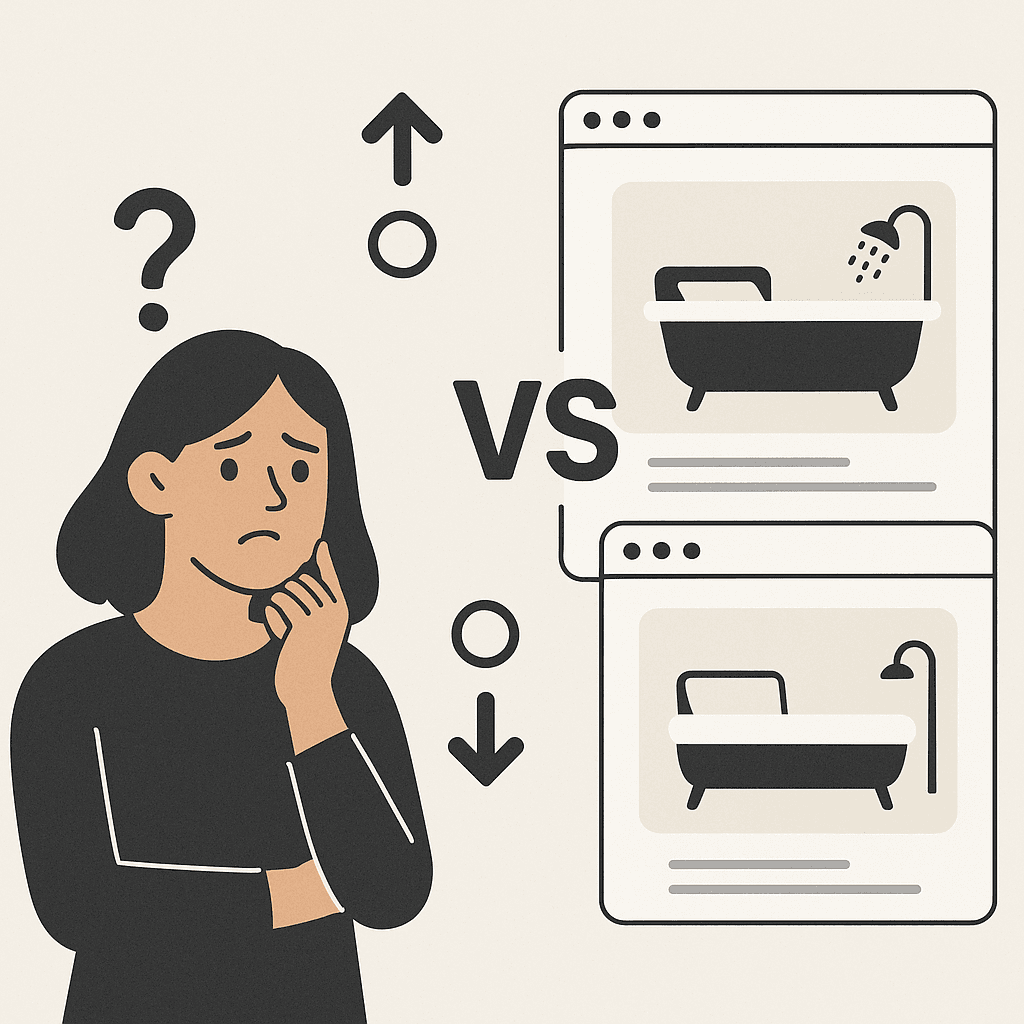
Let's walk through the math with concrete numbers. Say you have 10,000 monthly visitors: 6,000 from your robes campaign (60%) and 4,000 from your baby essentials campaign (40%). Hero A converts robes visitors at 4% and baby visitors at 1%. Hero B converts robes visitors at 2% and baby visitors at 5%.
Here's how the test plays out:
- Hero A total conversions: (6,000 × 4%) + (4,000 × 1%) = 240 + 40 = 280 conversions
- Hero B total conversions: (6,000 × 2%) + (4,000 × 5%) = 120 + 200 = 320 conversions
Hero B wins. You roll it out. But here's what happens when your traffic mix shifts next month to 70% robes and 30% baby (maybe you scaled up the robes campaign or a baby promotion ended):
- Hero B total: (7,000 × 2%) + (3,000 × 5%) = 140 + 150 = 290 conversions
Revenue drops by 30 conversions. Not because Hero B got worse, but because your traffic mix changed. You were never testing which copy was better. You were testing which copy fit that particular moment's traffic composition. The "winner" only wins under the exact conditions that produced it.
This is why so many teams run tests, implement winners, and see nothing happen. The test result was accurate for the test period. It just wasn't predictive of what would happen when real-world conditions shifted. Your A/B test winner isn't your best copy. It's your most average copy. For more on how to build experiences that adapt to different audiences, explore adaptive personalization strategies.
When Generic Copy Works (And When It Fails)

Generic copy isn't useless. It has a specific job, and dismissing it entirely would be lazy. The question is whether you're using it in the right situations.
Generic copy works when you genuinely don't know who's visiting. Organic traffic with mixed intent, returning visitors who might want anything, or broad brand awareness campaigns: these are situations where "Just dropped: the fall collection" or "Sitewide sale" makes sense. You're casting a wide net because you have to. Generic messaging also helps with SEO and general discoverability, where broad relevance matters more than precision targeting.
Generic copy fails when you already know who the visitor is. If someone clicked an ad about luxury robes, they told you exactly what they want. Showing them generic "Shop Now" messaging wastes that signal. They clicked because of a specific promise, and the landing page should deliver on it. When the generic message contradicts or ignores the promise that got them there, you lose trust and conversions. Research from a leading consulting firm shows that personalization in ecommerce can significantly impact revenue, but only when implemented correctly.
The problem isn't generic copy itself. The problem is using generic copy when you have segmentation data and choosing not to use it. If you're paying to acquire traffic from specific campaigns with specific messaging, your landing page should continue that conversation, not start a new one.
How to Test Within Segments

Here's where most conversion rate optimization for ecommerce advice gets vague. Everyone says "personalize" and "segment," but few explain the actual mechanics. Let's fix that.
Define Segments by Traffic Source
Don't overthink personas. Start with what you already know: where visitors came from. Visitors from your robes campaign should see robes-focused messaging. Visitors from your baby campaign should see baby-focused messaging. Use UTM parameters to identify traffic sources and route visitors accordingly.
This isn't complicated. Most analytics tools already track UTM parameters. The only new step is using that data to show different content, not just to report on it. You can implement these variations without developers using visual editing tools.
Run Parallel Tests, Not Sequential Tests
Instead of testing Hero A vs Hero B across all traffic, run two separate tests:
- Test Hero A1 vs Hero A2 for robes campaign traffic
- Test Hero B1 vs Hero B2 for baby campaign traffic
Now you're measuring actual copy effectiveness. A1 vs A2 tells you which robes messaging works best for robes shoppers. B1 vs B2 tells you which baby messaging works best for baby shoppers. You get two winners that are genuinely better for their audiences, not one compromise that's mediocre for everyone.
Match CTAs to Visitor Intent
If someone clicked an ad about robes, the CTA should say "Shop Robes," not "Shop Now." This sounds obvious, but most sites don't do it. They use generic CTAs everywhere because it's easier to maintain. Intent-based CTAs acknowledge why the visitor is there and guide them toward what they actually want. The improvement in conversion rate is often significant because you're removing friction, not adding it.
Measure by Segment, Not Aggregate
Stop obsessing over site-wide conversion rate. A 3% aggregate rate might be masking a 5% rate for one segment and a 1% rate for another. Fix the 1%, and your aggregate jumps without touching the segment that's already working. Look at conversion rate by traffic source, not just in total. The segment view tells you where to focus; the aggregate view hides the problem.
What Changes When You Segment
Let's be honest about what this approach requires and what it delivers.
What you gain:
- Tests that measure copy effectiveness, not traffic mix
- Results that stay stable when your traffic composition shifts
- The ability to optimize each audience independently
- Clear signal about which segments are underperforming and need work
What you give up:
- Simplicity: you're now running multiple tests instead of one
- Speed: segmented tests need more traffic per segment to reach significance
- A single "right answer": different segments will have different winners
This is more work. Running parallel tests, managing multiple variations, tracking results by segment. It takes more effort than picking one winner and calling it done. But it's also the only way to actually optimize conversion rate for ecommerce instead of optimizing for the mythical average visitor who doesn't exist. You can learn more about adapting content for different buying stages in this guide to funnel-based personalization.
Getting Started

You don't need to overhaul everything at once. Start with a simple validation to see if segmented testing is worth the effort for your site.
Your First Segmented Test
- Identify your top 3 traffic sources: Look at your analytics. Which campaigns or channels drive the most volume and ad spend?
- Check if they convert at different rates: Pull conversion rate by source. If there's a meaningful gap (say, 4% vs 2%), you have a segmentation opportunity.
- Create one variation per segment: For your highest-traffic page, build a version tailored to each major traffic source. Match the messaging to the campaign that sent them.
- Run parallel tests for 2-4 weeks: Test within each segment. Let traffic volume determine how long you need for significance.
- Compare segment-specific winners to your current site-wide winner: If the segmented winners outperform, you've validated the approach. Scale from there.
The goal isn't perfection on day one. It's proving that segmented testing delivers better results than site-wide testing. Once you see the difference in one test, the case for scaling becomes obvious.

Stop Optimizing for the Average Visitor
Your A/B test winner reflects your traffic mix, not your copy quality. Segmented testing shows the right content to the right visitors, turning flat results into real revenue growth. Stop guessing which message works for everyone and start knowing which message works for each audience.